How to Read Sheet Music: Faster Note Reading in Treble and Bass Clef
The notes on the lines and spaces, landmark notes, and how to read chords by their shape — explained with examples for both treble and bass clef.
Updated:
If reading sheet music feels slow, you may be counting up from the bottom one note at a time: “C, D, E…”. This article shows how to learn the notes on the lines and spaces, which landmark notes save you from counting, and how to read chords by their shape — with examples.
Lines and spaces
The five lines of the staff are numbered from the bottom: the 1st to 5th lines. The gaps between them are the 1st to 4th spaces. Notes that go above or below the staff are written with short extra lines called ledger lines.
Notes alternate between lines and spaces: a line note, then a space note, then a line note again. So once you know the line notes and the space notes, everything in between falls into place.
Treble clef notes
The treble clef curls around the 2nd line. That line is G, which is why it is also called the G clef.
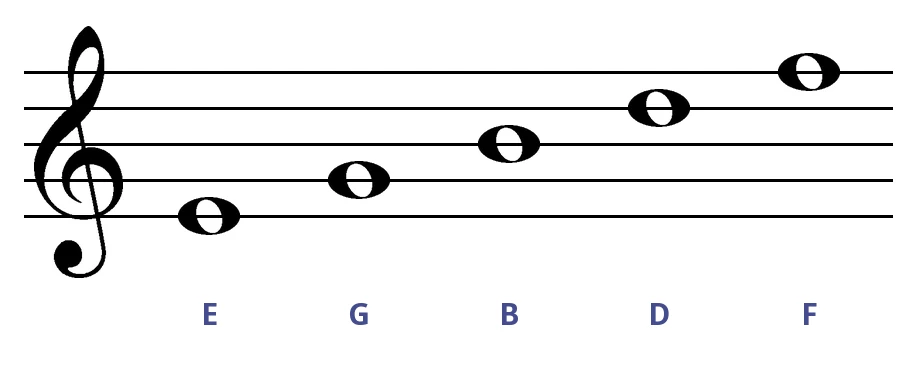
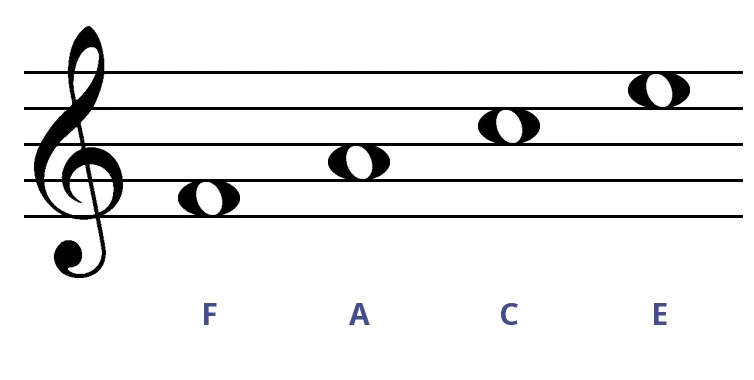
A common memory aid: the lines spell “Every Good Boy Does Fine” (E-G-B-D-F), and the spaces spell F-A-C-E.
Bass clef notes
The two dots of the bass clef sit on either side of the 4th line. That line is F, which is why it is also called the F clef. The same position gives a different note than in treble clef, so learn bass clef on its own.
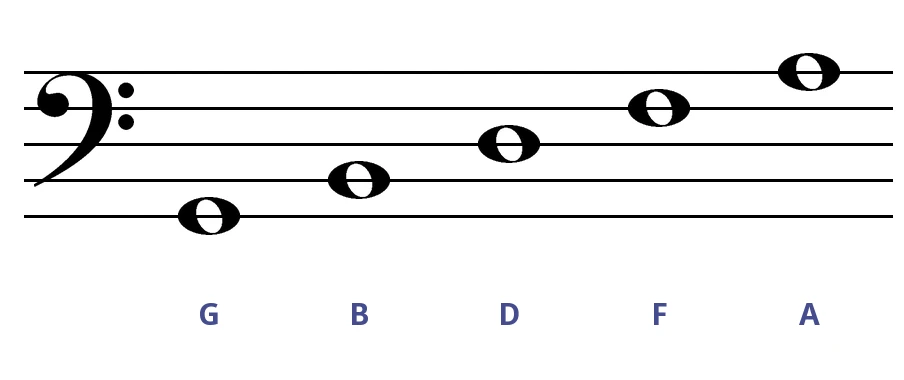
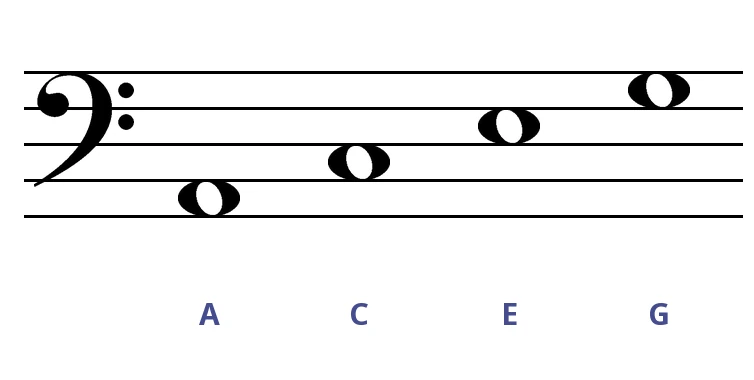
Memory aids: the lines are “Good Boys Do Fine Always” (G-B-D-F-A), and the spaces are “All Cows Eat Grass” (A-C-E-G).
Count from landmark notes
If learning every position at once feels like a lot, pick a few landmark notes first. Reading by distance from a landmark is faster than counting from the bottom.
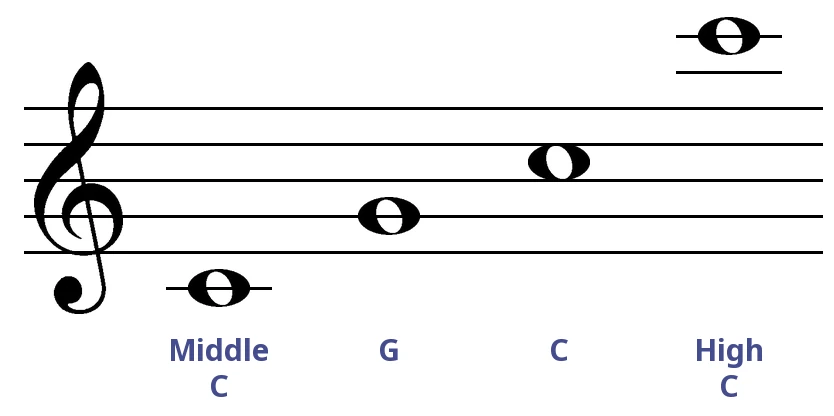
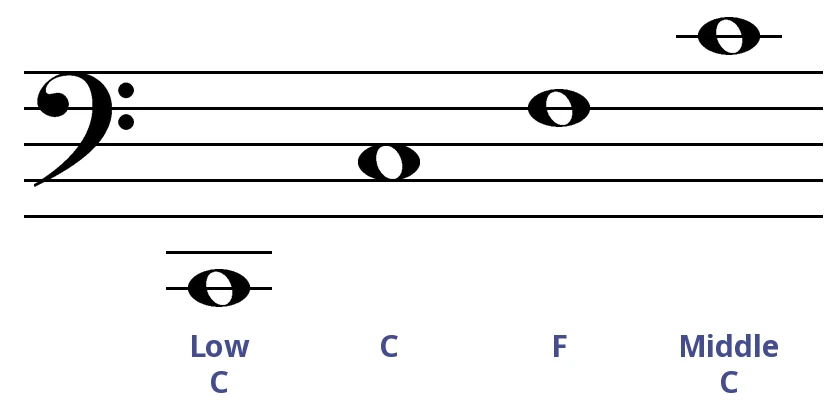
- Middle C: on the first ledger line below the treble staff, and on the first ledger line above the bass staff. It is near the middle of the piano, and it is the same note in both clefs
- Treble G and bass F: the notes that give the clefs their names (2nd line and 4th line)
- The C an octave up or down: the 3rd space in treble clef and the 2nd space in bass clef are both C. The C two ledger lines away is also easy to remember by counting the ledger lines
One step above or below a landmark switches between line and space. For example, in treble clef the 2nd space just above G (2nd line) is A, and the 1st space just below is F.
Read chords by their shape
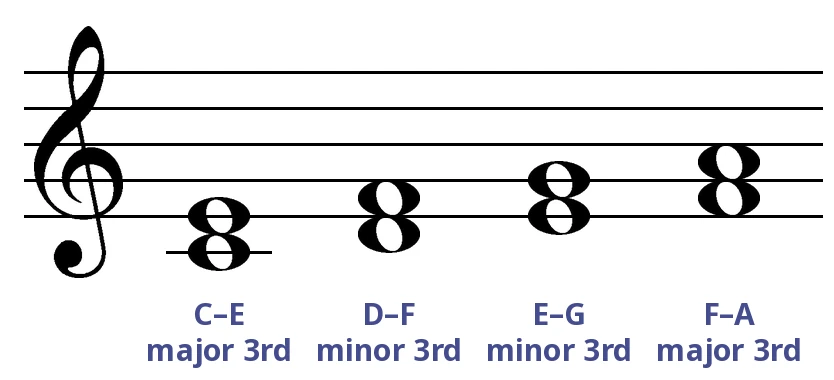
A chord built by stacking every other note (in thirds), like C–E–G, is called a triad. In root position — stacked upward from its lowest note — the three notes are all on lines or all in spaces. Once you read the bottom note, the shape tells you the rest: “line, line, line” means notes stacked in thirds.
The same chord rearranged, such as E–G–C (C moved to the top), is an inversion, and then lines and spaces mix. Learn the root‑position shapes first.
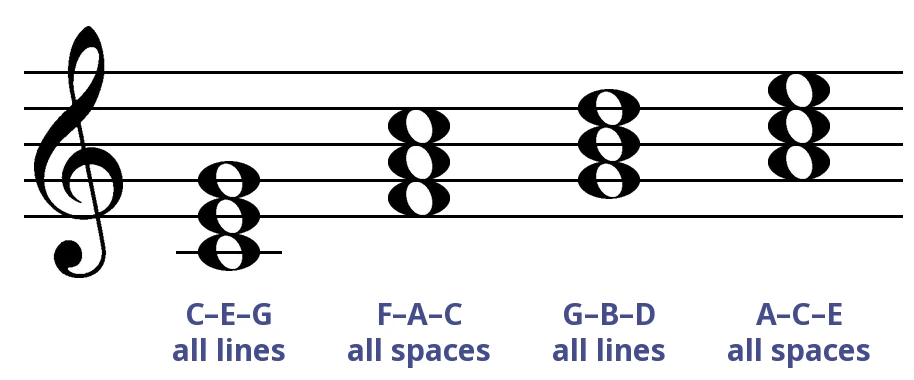
You can also see the distance between two notes from their shape. A line and the next space (or a space and the next line) is a 2nd; a line and the next line (or a space and the next space) is a 3rd. Look at groups of notes rather than reading them one by one.
A practice plan
Here is one order for growing the set of notes you can read:
- Single notes in treble clef (no sharps or flats)
- Single notes in bass clef
- Two and three notes played together
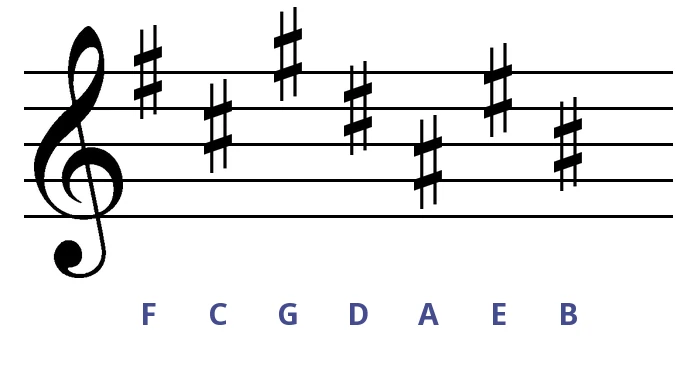
- Notes with sharps and flats
- Music with a key signature
Short sessions are fine — practicing every day is what counts. When your answers get faster, move on to the next step.
Practice with Vivo
In Vivo’s “Note Cards”, you look at a note on the staff and answer on the on-screen keyboard.
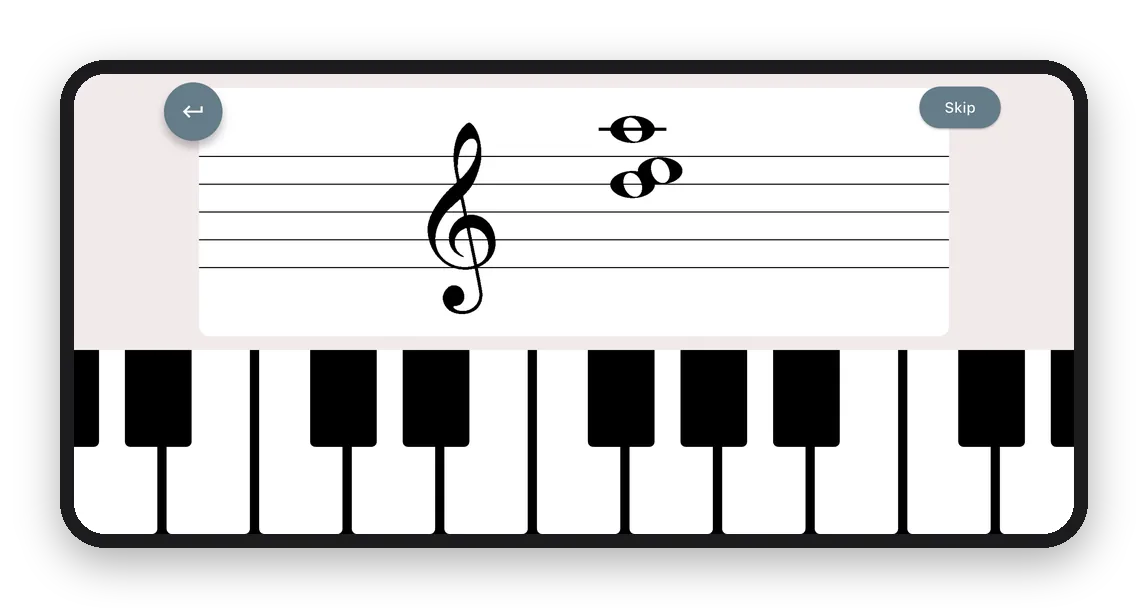
Before you start, you can choose what to practice:
- Clef: Treble clef or Bass clef
- Accidental: Sharp or Flat
- Chord: Single, Double or Triple
- Key: choose a key signature to read notes on a staff with that key signature
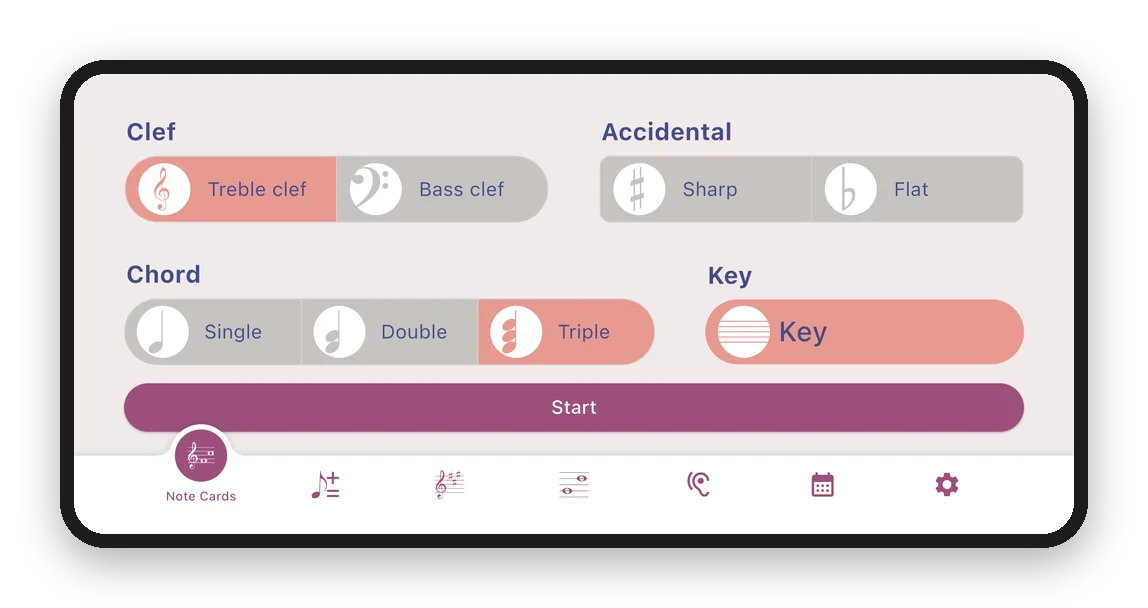
Change the settings in the order of the practice plan above to make it gradually harder. After each session, you can retry just the questions you missed.