How to Memorize Key Signatures: The Order of Sharps and Flats
The order in which sharps and flats appear, and how to find the major and minor key from a key signature — with examples and a full table.
Updated:
The sharps or flats at the start of each staff are the key signature. Once you know the order they come in and a couple of rules for finding the key, you can read any key signature just by counting.
What is a key signature?
A key signature is the group of sharps or flats written right after the clef. Every note named in it keeps its sharp or flat for the whole piece, in every octave. If the key signature has an F sharp, every F in the music is played as F♯. The exception is an accidental (♮, ♭, etc.) written before a note: it takes priority, but only until the end of that bar.
The number and type of sharps or flats tell you the key of the piece (C major, A minor and so on).
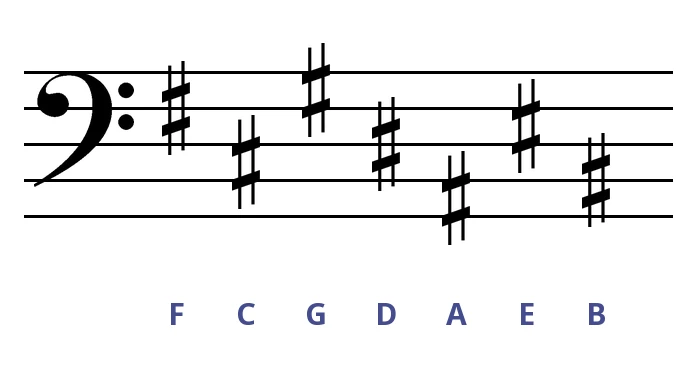
The order of sharps: F, C, G, D, A, E, B
Sharps are always added one at a time in this order. A key signature with two sharps has sharps on F and C.
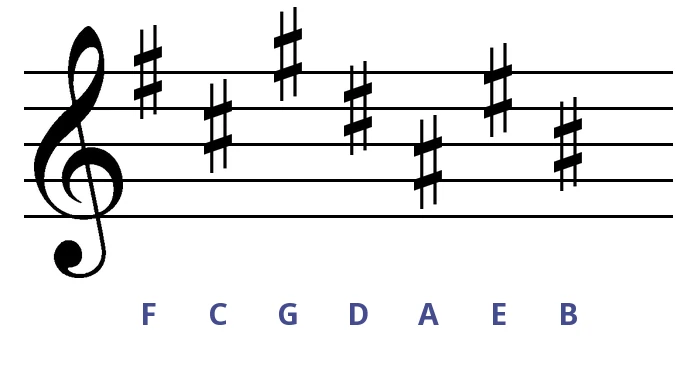
By note name, each sharp is a 5th above the previous one (F → C → G…). On the staff, some steps go down a 4th instead of up a 5th, so the sharps zigzag up and down. A popular memory aid is “Father Charles Goes Down And Ends Battle”.
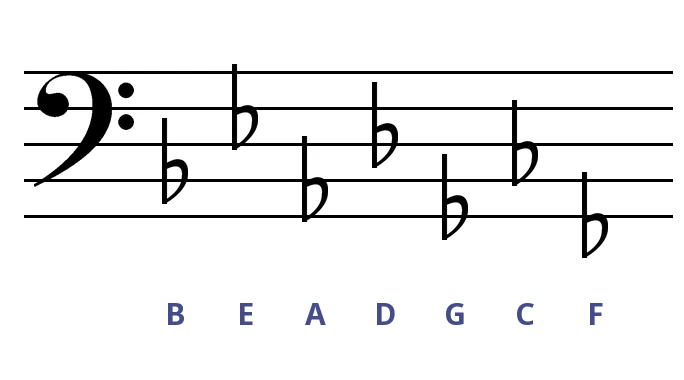
The order of flats: B, E, A, D, G, C, F
The order of flats is exactly the order of sharps read backwards — so the sentence also works in reverse: “Battle Ends And Down Goes Charles’ Father”.
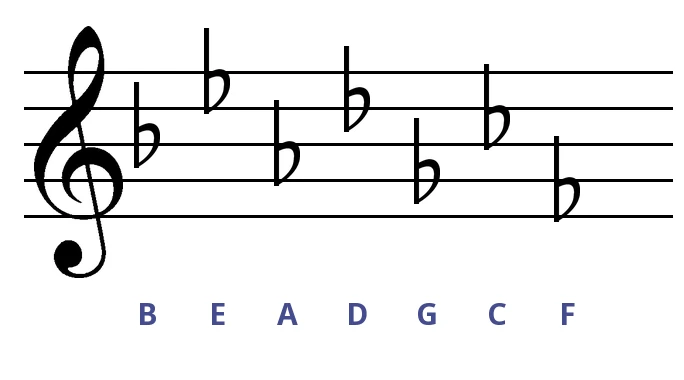
The order is the same in bass clef. Each sign is written a 3rd lower than in treble clef (the distance from one line to the next).
Finding the major key
Sharp key signatures
The note a half step above the last sharp is the tonic (the home note) of the major key.
- 1 sharp (F) → a half step above F♯ is G → G major
- 2 sharps (F, C) → a half step above C♯ is D → D major
- 3 sharps (F, C, G) → a half step above G♯ is A → A major
Flat key signatures
The second-to-last flat names the major key. With only one flat there is no second-to-last, so just remember F major.
- 2 flats (B, E) → the second-to-last is B♭ → B♭ major
- 3 flats (B, E, A) → the second-to-last is E♭ → E♭ major
The minor key with the same key signature
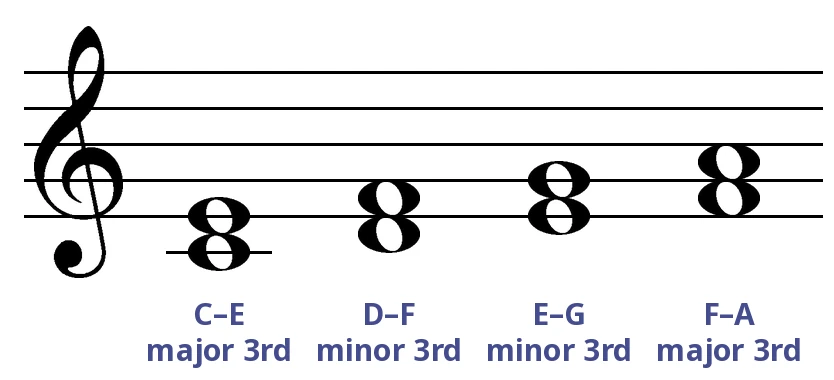
Each key signature belongs to one major key and one minor key (relative keys). The minor tonic is a minor 3rd below the major tonic — or think of it as the 6th note of the major scale.
- No sharps or flats: C major → a minor 3rd below C is A → A minor
- 1 sharp: G major → a minor 3rd below G is E → E minor
- 1 flat: F major → a minor 3rd below F is D → D minor
To decide between major and minor from the music, look at the final note or chord, and at accidentals typical of minor keys (such as a sharp on the note a half step below the tonic).
Table of key signatures
| Key signature | Major | Minor |
|---|---|---|
| None | C major | A minor |
| 1♯ | G major | E minor |
| 2♯ | D major | B minor |
| 3♯ | A major | F♯ minor |
| 4♯ | E major | C♯ minor |
| 5♯ | B major | G♯ minor |
| 6♯ | F♯ major | D♯ minor |
| 7♯ | C♯ major | A♯ minor |
| 1♭ | F major | D minor |
| 2♭ | B♭ major | G minor |
| 3♭ | E♭ major | C minor |
| 4♭ | A♭ major | F minor |
| 5♭ | D♭ major | B♭ minor |
| 6♭ | G♭ major | E♭ minor |
| 7♭ | C♭ major | A♭ minor |
Practice with Vivo
In Vivo’s “Key” practice, you look at a key signature and answer with the tonic of that key.
- Open the “Key” tab at the bottom of the screen and choose “Key”
- Choose major key or minor key
- Pick the tonic of the key signature from the note cards below
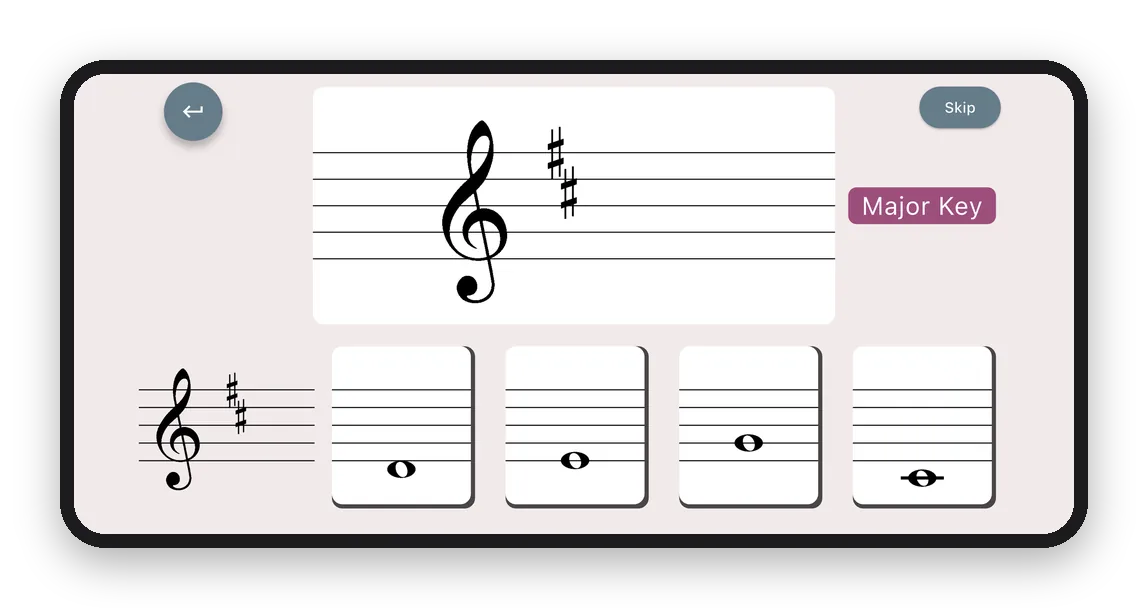
Questions cover all 15 key signatures in the table above (major and minor). Once the tonic comes to you quickly, try “Related Keys” in the same tab to name the parallel, relative, dominant and subdominant keys. Choosing a key signature in the “Note Cards” settings also lets you practice reading music with a key signature.