How to Count Intervals: Numbers and Qualities (Major, Minor, Perfect, Augmented, Diminished)
Count any interval in two steps — the number and the quality — with staff examples and a table of half steps.
Updated:
Intervals such as “major 3rd” or “perfect 5th” are easy to work out if you split them into two parts: the number and the quality (major, minor, perfect, augmented, diminished). This article explains how to count the number, how to tell the quality, and what to do with sharps and flats.
Counting the number: include both ends
The number is how many letter names the two notes span on the staff, counting both notes. From C up to E is “C, D, E” — three letters, so a 3rd. Two notes at the same pitch are a unison (1st), and C to the next C up is an octave (8th).
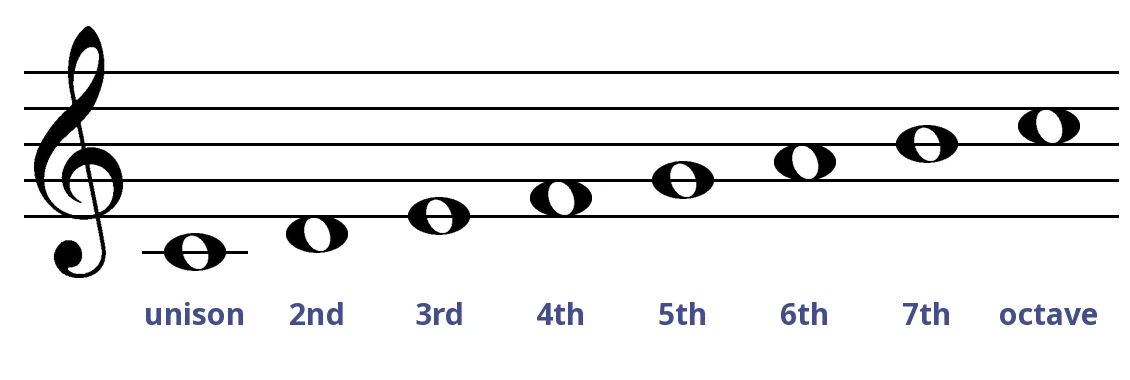
The number ignores sharps and flats. C to E and C to E♭ are both 3rds. The difference is shown by the quality, below.
Telling the quality
Each number uses its own set of qualities:
- Unison, 4th, 5th, octave: perfect, augmented, diminished (there is no diminished unison)
- 2nd, 3rd, 6th, 7th: major, minor, augmented, diminished
The quality is set by the number of half steps between the two notes. On the piano, any two neighboring keys (white or black) are one half step apart.
| Interval | Half steps | Example (from C) |
|---|---|---|
| Perfect unison | 0 | C–C |
| Minor 2nd | 1 | C–D♭ |
| Major 2nd | 2 | C–D |
| Minor 3rd | 3 | C–E♭ |
| Major 3rd | 4 | C–E |
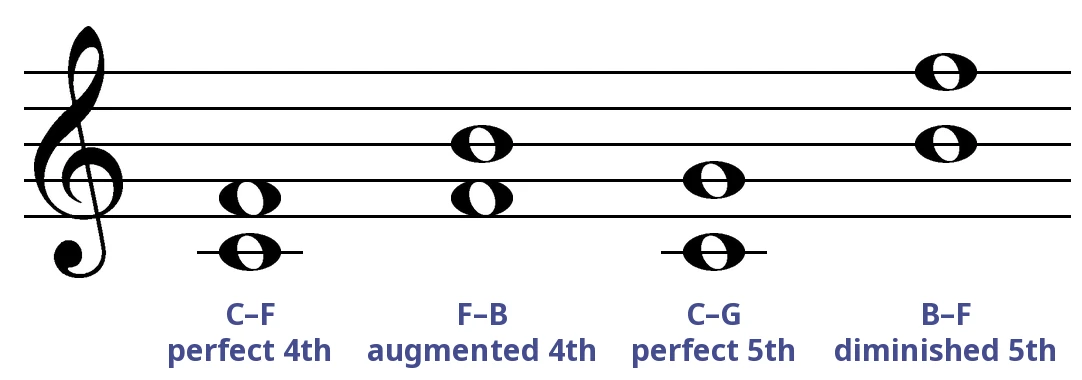
| Perfect 4th | 5 | C–F |
| Augmented 4th | 6 | C–F♯ |
| Diminished 5th | 6 | C–G♭ |
| Perfect 5th | 7 | C–G |
| Minor 6th | 8 | C–A♭ |
| Major 6th | 9 | C–A |
| Minor 7th | 10 | C–B♭ |
| Major 7th | 11 | C–B |
| Perfect octave | 12 | C–C (an octave up) |
The augmented 4th and the diminished 5th have the same number of half steps, but they are different intervals because their numbers differ. Which one it is depends on the positions on the staff (the number).
A shortcut for white-key intervals
Among the white keys (C, D, E, F, G, A, B), the only half steps are E–F and B–C. Every other pair of neighbors is a whole step (two half steps). With this, you can tell intervals without counting every half step.
2nds and 3rds
- 2nds: only E–F and B–C are minor 2nds; the rest are major 2nds
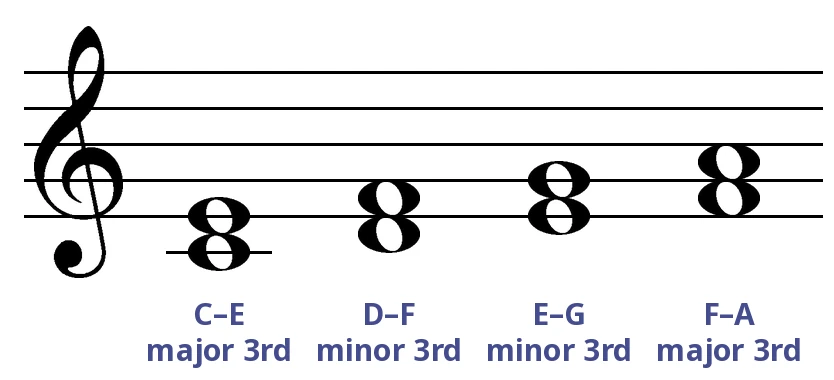
- 3rds: if the 3rd contains E–F or B–C it is a minor 3rd (D–F, E–G, A–C, B–D); otherwise it is a major 3rd (C–E, F–A, G–B)
4ths and 5ths
- 4ths: only F–B is an augmented 4th; the rest are perfect 4ths
- 5ths: only B–F is a diminished 5th; the rest are perfect 5ths
6ths and 7ths
For 6ths and 7ths, check the half steps in the table above, or move the top note down an octave. Moving the A of C–A (major 6th) down an octave gives A–C, a minor 3rd. When you invert an interval like this, major becomes minor, minor becomes major, augmented becomes diminished and diminished becomes augmented (perfect stays perfect), and the number becomes “9 minus the original” (6th ↔ 3rd, 7th ↔ 2nd).
With sharps and flats
First remove the sharps and flats and find the white-key interval. Then change the quality depending on whether the sharp or flat makes the interval a half step wider or narrower.
- A half step wider: minor → major → augmented, perfect → augmented
- A half step narrower: major → minor → diminished, perfect → diminished
Some examples:
- C–E♭: the top note of C–E (major 3rd) goes down a half step, so it gets narrower → minor 3rd
- C♯–E: the bottom note of C–E (major 3rd) goes up a half step, so it gets narrower → minor 3rd
- F–B♭: the top note of F–B (augmented 4th) goes down a half step → perfect 4th
- C–G♯: the top note of C–G (perfect 5th) goes up a half step → augmented 5th
One more half step wider than augmented is doubly augmented; one more half step narrower than diminished is doubly diminished.
Practice with Vivo
In Vivo’s “Interval” practice, you look at two notes on the staff and answer with the quality and the number.
- Open the “Interval” tab at the bottom of the screen and press “Start”
- Read the interval between the two notes on the staff
- Choose the quality (Perfect, Major, Minor, Augmented, Diminished, Doubly Augmented, Doubly Diminished) with the buttons on the left, and the number (1–8) with the buttons on the right
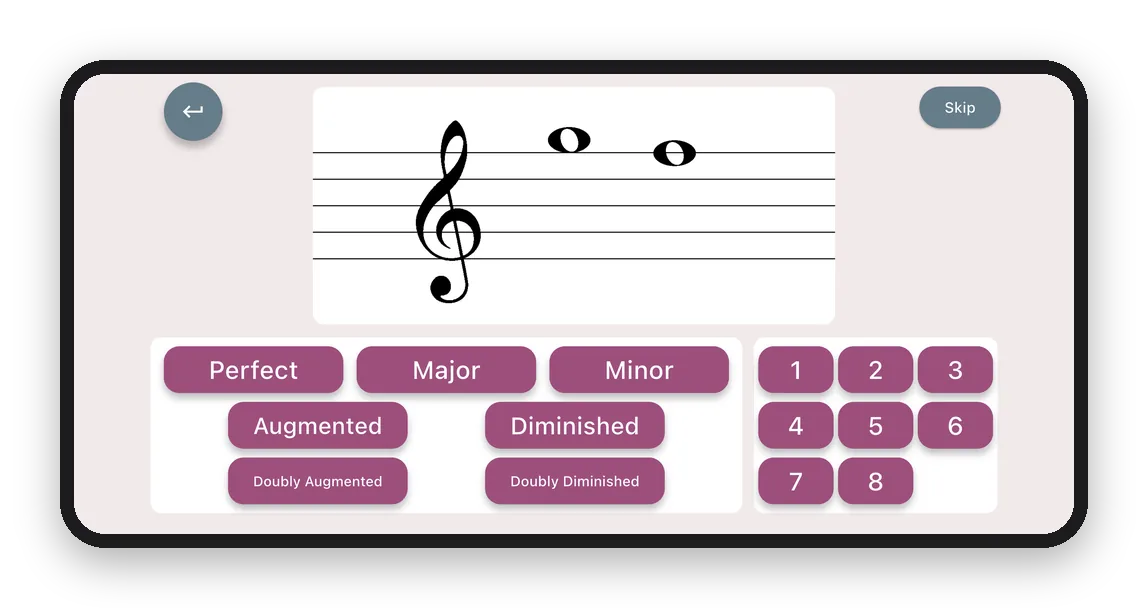
The answer is correct when both the quality and the number match. To train your ear instead, “Pitch Interval” in the “Ear Training” tab plays two notes and asks you to choose from 12 intervals, from minor 2nd to octave.